
AI for weather and climate modelling
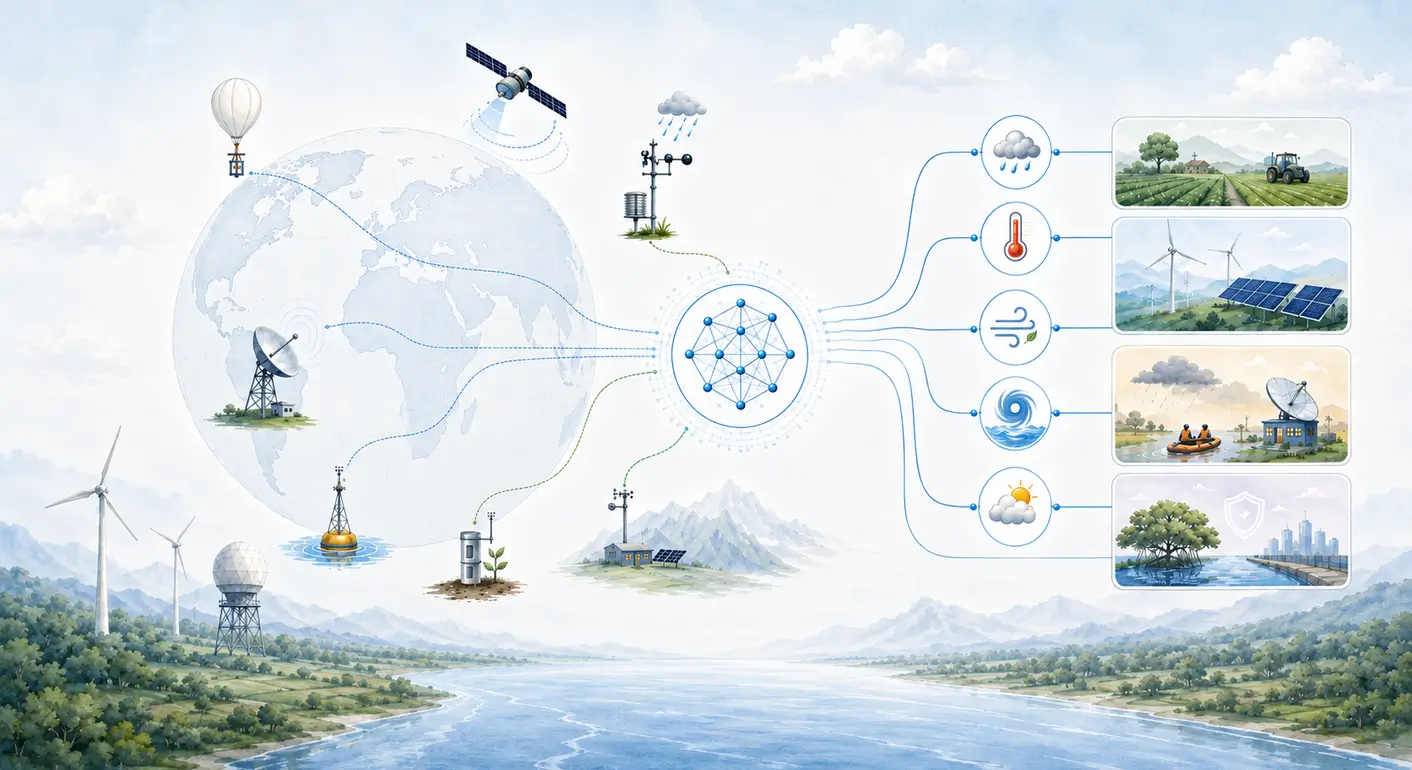
This group focuses on improving weather forecasts for India with data-driven methods to help mitigate the impacts of climate change and help various downstream applications like energy, agriculture and disaster management. We work with various agencies like the Indian Met Department to get access to relevant weather data and develop models on them.
Some of our projects are:
Combining weather forecasts: Instead of relying on a single model, we treat GenCast, AIFS, GEFS, IFS-ENS, and other forecast sources as competing experts. Offline methods optimize CRPS to produce calibrated ensemble blends, while online mathematical methods adapt weights over time, by region, lead time, etc, leading to theoretically bounded guarantees.
Radar research: This addresses the short-range precipitation problem, where global models are too coarse and too slow to capture convective storms. The radar program covers three linked tasks: reconstructing radar reflectivity from satellite and sounding inputs, temporal nowcasting of future radar frames, and spatial gap-filling for missing or corrupted radar regions. Together, these build toward reliable 0- to 4-hour rainfall intelligence for Delhi and surrounding regions.
Air quality forecasts and monitoring: We want to improve air quality forecasts and monitoring, with the help of foundation models like Aurora and on ground CPCB data. We can get a foundation atmospheric representation that is coupled with CPCB pollutant observations, meteorology, boundary-layer signals, and regional transport features. The target is high-resolution forecasts of PM2.5, PM10, NO2, and O3 over Delhi, with evaluation against station observations and persistence baselines.
Finetuning global weather models: We also finetune global weather models to India with India-specific data to obtain improvements.
Real-time forecasting: This turns the research stack into an operational system. Our in progress dashboard ingests observations, loads forecasts, computes station-level metrics, and visualizes errors by lead time and diurnal cycle. This closes the loop between research models and daily forecast monitoring.
High-resolution forecasting: Using radar, satellite, and station data, we also want to produce higher resolution forecasts to obtain more granular information about future weather conditions.
Subseasonal-to-seasonal (S2S) forecasting: We also plan to develop AI models for subseasonal-to-seasonal (S2S) forecasting that improves prediction of weather patterns 4-6 weeks, a notable gap currently. These forecasts support agriculture, water management, disaster preparedness, energy planning, and climate resilience.
Benchmarking AI models: We are actively benchmarking the AI weather models for India to see changes in performance.